Sustainable stays in Bangkok: lower-impact hotels and how to pick one
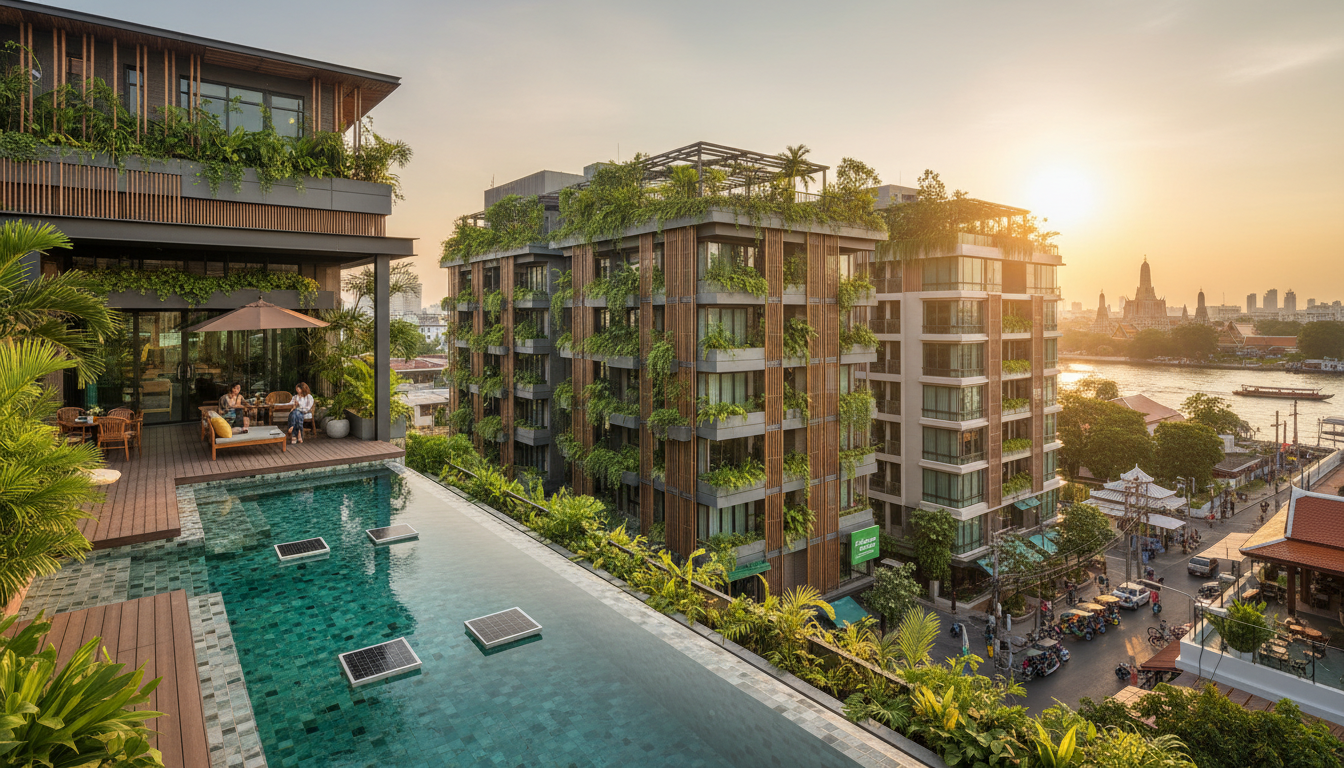 Green-lung cycling path and low-rise eco lodge across the river from central Bangkok
Bangkok's greenest choice is rarely a badge on the website — it is where you sleep and how you move; here is how to pick a genuinely lower-impact stay.
The certifications worth checking, and the ones that mean nothing
Thailand runs its own hotel eco-rating, the Green Leaf Foundation programme, which has scored properties from one to five leaves on energy, water, waste and staff training since 1998; a four- or five-leaf rating is a genuine signal because an external auditor visits the building. Above that sit the international marks — EarthCheck, which several Bangkok five-stars hold, Travelife, and LEED for the building itself. A hotel wearing a Green Leaf four, an EarthCheck certificate dated within two years, or a LEED plaque has done measurable work. What means nothing: a soft 'we care about the planet' page, a single linen-reuse card, or a generic badge the hotel awarded itself.
The label tells you the building's systems are efficient; it does not tell you the room will suit you, so read it alongside the basics. A certified property should give you glass or refillable water instead of two plastic bottles a day, refillable wall-mounted amenities rather than 30ml plastic miniatures, and a key-card power slot that actually cuts the air-conditioning when you leave. If the booking page shows plastic-wrapped everything in the room photos, the certificate is either old or cosmetic. Decision: shortlist by certification, then confirm the plastic and amenity details in the most recent guest photos, which are far harder to stage than the hotel's own gallery.
Location is the biggest lever, bigger than any in-room gesture
The largest slice of a Bangkok trip's footprint is not the hotel's laundry — it is how you move around a city where a single cross-town taxi in traffic can idle for 40 minutes. Stay inside the BTS and MRT walkable core and you replace most of those rides with a train. The strongest clusters are Asok and Phrom Phong on the Sukhumvit line and Sala Daeng on Silom, all with interchange access, malls, food and parks within a 10-minute walk. A solid four-star in this band runs $110-180 a night. From here the Grand Palace is about 25 minutes by rail and Chatuchak market roughly 20, with almost no taxi needed all day.
Compare that with a cheaper hotel out in Ratchada, Srinakarin or the far end of On Nut, where the nightly rate might be $45 but every outing becomes a Grab ride. Four taxi trips a day at $4-7 each is $20-28 of fuel-burning, traffic-bound travel plus the lost time, and it quietly erases the saving. The riverside is the other low-impact base: from a Saphan Taksin-area hotel the Chao Phraya Express Boat moves you between the Old City, Chinatown and Iconsiam for $0.50-1.50 a hop on a route that carries thousands and adds no road traffic. Decision: pick a base you can leave on foot or by rail, and the transport footprint takes care of itself.
The genuinely green places to sleep, ranked by how far you will go
For the real thing, Bangkok Tree House sits across the river in Bang Krachao, the jungle-covered peninsula locals call the green lung. It is a small solar-assisted eco-lodge built largely from reclaimed timber, reached by a longtail ferry from the Bang Nam Phueng side and a short cycle or walk — no car reaches the door. Rooms run roughly $180-260 and sell out well ahead in cool season, so book three to four weeks early for December to February. You trade central convenience for birdsong, bicycle paths and near-zero road noise; it suits a two- or three-night slow stay, not a sightseeing sprint back into the city centre each morning.
In town, the credible large hotels pair certification with visible practice. Sindhorn Kempinski near Lumphini Park gives rooms glass water bottles and sits inside the landscaped Sindhorn Village, a genuine green pocket, with rates around $220-320. Bangkok Marriott Marquis Queen's Park on Sukhumvit Soi 22 runs an established waste and energy programme and is a five-minute walk from BTS Phrom Phong at $150-230. The riverside Shangri-La and Chatrium both hold long-running efficiency schemes and put you straight onto the express boat. Decision: if you want central and comfortable, take the certified Sukhumvit four-to-five-star near a BTS door; if a lighter footprint is the point of the trip itself, cross to Bang Krachao.
The in-stay moves that cut the most, in order
Rank your own habits by impact and the list is short. First, air-conditioning: Bangkok hotels default the thermostat to 18-20°C, so set it to 24-25°C and you cut the room's single largest energy draw by roughly a third while still sleeping cold in a 33°C city. Second, skip daily housekeeping — hang the 'no service' card and you save a full laundry and cleaning-chemical cycle per night, and many chains now credit loyalty points for it. Third, refill water: a room-shop bottle is $1-1.50 and you will drink three a day, so carry a bottle and use the lobby filter station or a 7-Eleven's $0.30 large bottle instead of the plastic minis.
Food is the quiet one. Eating where the city eats — street stalls, fresh markets like Or Tor Kor, and neighbourhood shophouses — runs a far shorter supply chain than an import-heavy hotel buffet, and a $2-4 plate beats a $35 breakfast on both cost and footprint. Skip the Chao Phraya dinner-cruise buffets, which truck food to a boat to serve a mediocre spread. Refuse the plastic straw and bag by default; Thailand dropped single-use bags from major stores in 2020 and a quick 'mai ao thung' ('no bag needed') is understood everywhere. Decision: set the aircon, drop the daily clean, refill water and eat local — four habits that together outweigh any single certificate.
A low-impact day that proves the point: Bang Krachao
You do not have to stay green to travel green for a day. From the Sukhumvit core, take the MRT or a short Grab to the Klong Toei or Wat Bang Na side, cross by the roughly $0.20 longtail ferry to Bang Krachao, and rent a bicycle for about $2-3 at the pier. The peninsula is laced with raised concrete cycle paths through mangrove and banana groves, with the Bang Nam Phueng floating market open weekend mornings for $1-2 plates. Sri Nakhon Khuean Khan Park at its centre has a birdwatching tower and lotus ponds, is free to enter, and runs two to three degrees cooler than the city under its canopy.
Time it for a weekend morning, arrive by 09:00 before the heat peaks, and you can ride the loop in three to four hours. Bring water and cash — there are no ATMs deep in the peninsula and few shops take cards. The return ferry runs until early evening, so a lunch of grilled river fish at the market and a slow ride back still gets you to a Sukhumvit dinner easily. Decision: whether or not your hotel carries a green leaf, a car-free morning here is the lowest-impact and quietly the best half-day in Bangkok — skip one mall afternoon to make room for it.
Before you book
What people ask before booking Bangkok.
Yes — the Green Leaf Foundation, running since 1998, audits hotels and rates them one to five leaves on energy, water, waste, purchasing and staff training. A four- or five-leaf property has passed an external inspection, which makes it far more trustworthy than a self-declared 'eco' badge. Ask the hotel directly for its current leaf rating and the year it was awarded.
Bangkok tap water is chlorinated and safe at the source but travels through old building pipes, so most visitors do not drink it straight. Refilling is still easy: many hotels now have filtered lobby stations, and a large 7-Eleven bottle costs about $0.30 against $1-1.50 in the room. Carry a reusable bottle and you cut both plastic and cost across a week.
Not inherently. A certified Sukhumvit four-star sits in the normal $110-180 band, with no premium for the green programme itself. The eco-lodge option in Bang Krachao costs more, around $180-260, because it is small and remote rather than because it is green. The cheapest choice — a transit-connected room you can leave on foot — is often the lowest-impact one too.
Where you sleep, judged by transport. A hotel inside the BTS or MRT walkable core replaces about four car trips a day with trains and boats, which outweighs every in-room gesture combined. Pick Asok, Phrom Phong or a Saphan Taksin riverside base and the rest of your footprint shrinks almost automatically.
Book three to four weeks ahead for the December to February cool season, when the small number of rooms fill fast, and one to two weeks in the quieter, hotter months. Weekends go first because of the floating market and the cycling crowd. Midweek nights are easier to get and much quieter for riding the peninsula.